



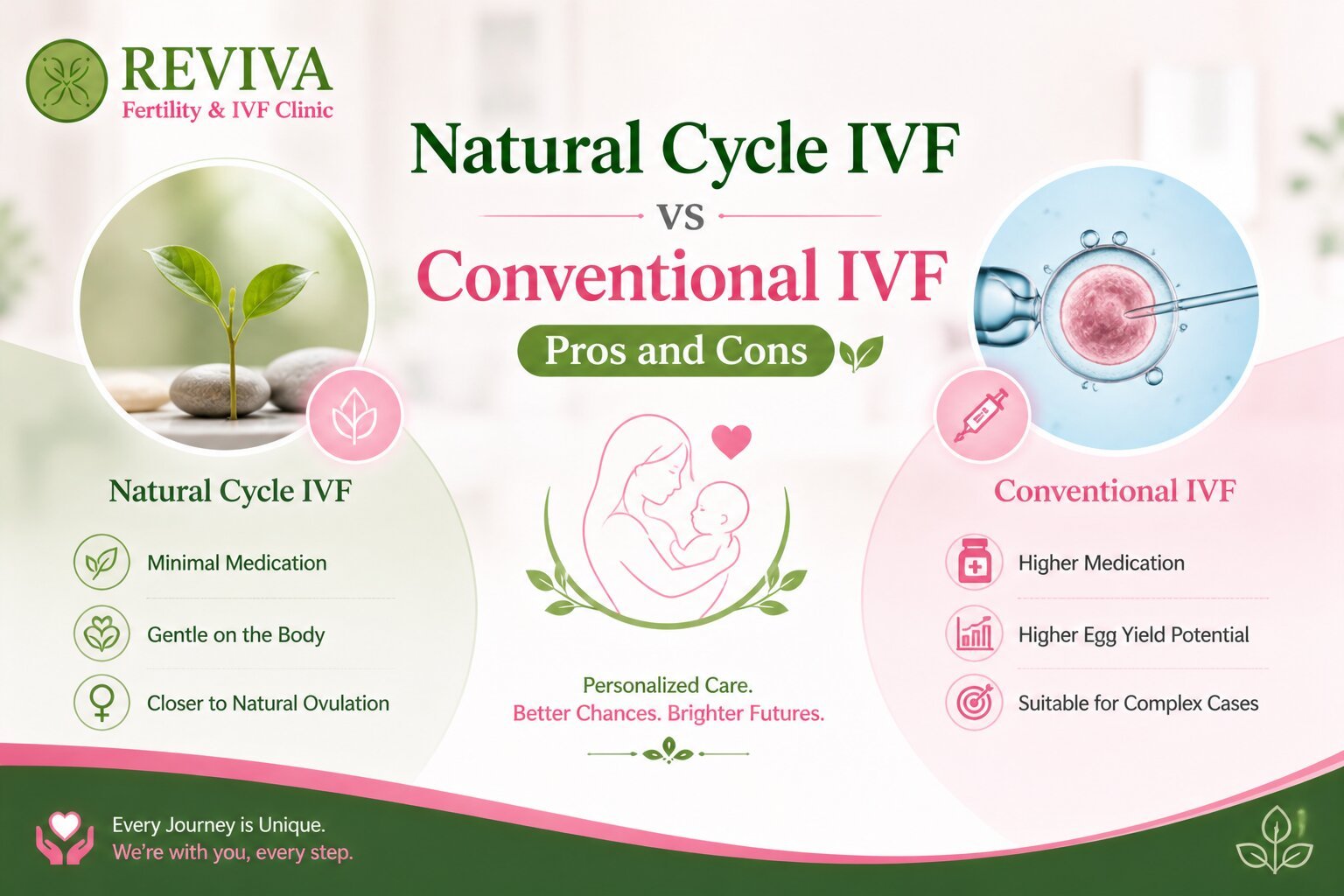
When couples explore in vitro fertilization (IVF), they often assume that every IVF treatment follows the same process. In reality, fertility specialists may use different ovarian stimulation approaches depending on a woman’s age, ovarian reserve, previous treatment response, medical history and treatment goals.
Two approaches that are sometimes compared are Natural Cycle IVF and Conventional IVF.
So, what is the difference between Natural Cycle IVF and Conventional IVF? Which IVF treatment is better? And who may be a suitable candidate for Natural Cycle IVF?
The simplest distinction is this:
Natural Cycle IVF generally attempts to retrieve the single egg that develops naturally during a woman’s menstrual cycle, while Conventional IVF uses fertility medications to stimulate the ovaries to develop multiple follicles and eggs.
Neither approach is automatically better for every patient. The appropriate treatment depends on individual fertility factors and the clinical strategy recommended by the fertility specialist.
What Is Natural Cycle IVF?
Natural Cycle IVF, sometimes called Natural IVF, is an IVF approach in which ovarian stimulation with fertility medications is minimized or avoided.
During a natural menstrual cycle, the ovaries typically select a dominant follicle. The fertility team monitors the cycle and aims to retrieve the naturally developing egg before ovulation.
If an egg is successfully retrieved, it may then be fertilized in the laboratory.
The basic process may involve:
- Monitoring the natural menstrual cycle
- Ultrasound and/or hormonal monitoring
- Timing the egg retrieval
- Retrieving the naturally developing egg
- Fertilizing the egg in the laboratory
- Culturing any resulting embryo
- Transferring an embryo if appropriate
Because Natural Cycle IVF usually produces only one egg, there may be fewer embryos available compared with a conventional stimulated IVF cycle.
What Is Conventional IVF?
Conventional IVF involves ovarian stimulation using fertility medications.
The objective is to encourage the ovaries to develop multiple follicles rather than relying on the single dominant follicle of a natural cycle.
During treatment, the fertility team monitors follicular development through ultrasound and sometimes blood tests.
Once the follicles are appropriately developed, a trigger medication may be given, followed by egg retrieval.
The retrieved eggs are then fertilized in the laboratory, and resulting embryos may be transferred or cryopreserved.
Natural Cycle IVF vs Conventional IVF: Key Difference
The main difference is the number of eggs the treatment attempts to obtain.
| Feature | Natural Cycle IVF | Conventional IVF |
| Ovarian stimulation | Minimal or none | Uses fertility medications |
| Expected eggs | Usually one | Usually multiple |
| Medication exposure | Lower | Higher |
| Monitoring | Required | Required |
| Risk of ovarian hyperstimulation | Very low | Higher than natural-cycle treatment |
| Number of embryos | Often limited | Potentially multiple |
| Need for repeated cycles | May be higher | May be lower for some patients |
| Suitability | Selected patients | Broadly used IVF approach |
The actual protocol can vary between fertility centres and individual patients.
How Does Natural Cycle IVF Work?
A Natural Cycle IVF treatment generally follows the woman’s natural menstrual cycle.
Step 1: Cycle Monitoring
The fertility team monitors follicular development.
Ultrasound may be used to determine whether a dominant follicle is developing.
Step 2: Timing Ovulation
The medical team carefully monitors the cycle to determine the appropriate time for egg retrieval.
Medication may sometimes be used to help control or time ovulation.
Step 3: Egg Retrieval
The mature follicle is aspirated to attempt to retrieve the egg.
Because there is generally only one target follicle, there may be a risk that no egg is retrieved.
Step 4: Fertilization
If an egg is retrieved, it can be fertilized in the laboratory.
Depending on sperm factors and the clinic’s treatment plan, conventional IVF or ICSI may be considered.
Step 5: Embryo Development
If fertilization occurs, the embryo is monitored as it develops.
Step 6: Embryo Transfer
If a suitable embryo develops and transfer is appropriate, it may be transferred to the uterus.
However, Natural Cycle IVF can sometimes result in no embryo being available for transfer.
How Does Conventional IVF Work?
Conventional IVF generally involves several stages.
Ovarian Stimulation
Fertility medications are administered to stimulate the development of multiple follicles.
Monitoring
Ultrasound examinations and, when appropriate, blood tests are used to monitor follicular development.
Trigger Medication
When the follicles reach an appropriate stage, medication is administered to trigger final egg maturation.
Egg Retrieval
Eggs are retrieved using a minimally invasive procedure.
Fertilization
The retrieved eggs are fertilized in the laboratory.
Embryo Culture
Embryos are monitored for development.
Embryo Transfer or Freezing
A suitable embryo may be transferred to the uterus, while additional suitable embryos may be cryopreserved for future use.
Advantages of Natural Cycle IVF
Natural Cycle IVF can have potential advantages for selected patients.
1. Less Ovarian Stimulation
Because the treatment generally relies on the natural development of a follicle, the amount of ovarian stimulation medication can be lower.
2. Lower Risk of Ovarian Hyperstimulation Syndrome
Because Natural Cycle IVF usually involves development of only one follicle, the risk of ovarian hyperstimulation syndrome (OHSS) is substantially lower than with stimulated IVF.
However, individual risks can vary.
3. Lower Medication Burden
Some patients prefer an approach involving fewer fertility medications.
This may be particularly relevant for women who have previously experienced difficulties with ovarian stimulation.
4. Lower Risk of Multiple Embryos From One Cycle
Because Natural Cycle IVF generally produces one egg, there is less opportunity to create multiple embryos from that cycle.
5. May Be Considered for Women Who Cannot or Prefer Not to Undergo Standard Stimulation
In selected circumstances, a fertility specialist may consider Natural Cycle IVF when conventional ovarian stimulation is unsuitable or when the patient prefers a lower-medication approach.
However, patient selection is important.
Disadvantages of Natural Cycle IVF
Natural Cycle IVF also has important limitations.
1. Usually Only One Egg Is Available
The biggest limitation is that there is generally only one egg to work with.
If the egg is not retrieved, does not fertilize or does not develop into a suitable embryo, the cycle may not result in embryo transfer.
2. Higher Risk of Cycle Cancellation
A natural cycle can be cancelled if premature ovulation occurs or if the follicle does not develop as expected.
3. Fewer Embryos May Be Available
Conventional IVF may produce several eggs and potentially several embryos.
Natural Cycle IVF usually does not provide the same opportunity.
4. Multiple Treatment Attempts May Be Required
Because each cycle may provide only one egg, some patients may need repeated attempts to obtain an embryo.
5. Not Suitable for Everyone
Natural Cycle IVF is not automatically appropriate for women with all types of infertility.
The fertility specialist needs to determine whether the expected benefit justifies the approach.
Advantages of Conventional IVF
Conventional IVF remains the more commonly used approach for many patients because ovarian stimulation provides an opportunity to retrieve multiple eggs.
1. Multiple Eggs Can Be Retrieved
Retrieving multiple eggs increases the opportunity for fertilization and embryo development within the same stimulation cycle.
2. Potentially More Embryos
If several eggs fertilize and develop appropriately, multiple embryos may become available.
Some may be transferred while others can potentially be frozen for future use.
3. More Treatment Opportunities From One Retrieval
If several suitable embryos are cryopreserved, the patient may have additional embryo-transfer opportunities without repeating ovarian stimulation and egg retrieval.
4. More Widely Applicable
Conventional IVF can be used in many different fertility situations, although the specific stimulation protocol is individualized.
Disadvantages of Conventional IVF
Conventional IVF also has disadvantages.
1. More Medication
Ovarian stimulation requires injectable or other fertility medications.
2. More Monitoring
Patients generally require several appointments for ultrasound and sometimes blood tests.
3. Risk of Ovarian Hyperstimulation
Ovarian stimulation can increase the risk of OHSS, although modern IVF protocols and preventive strategies have substantially improved safety.
4. Physical and Emotional Burden
IVF involves appointments, medication, procedures and uncertainty, which can be emotionally demanding.
5. Higher Treatment Complexity
Compared with Natural Cycle IVF, conventional IVF generally involves more medications, monitoring and clinical intervention.
Natural Cycle IVF vs Conventional IVF: Which Is Better?
There is no universal answer.
Natural Cycle IVF is not simply a “safer version” of conventional IVF, and conventional IVF is not automatically better for every woman.
The treatment approach should be based on the patient’s individual circumstances.
A doctor may consider:
- Age
- Ovarian reserve
- Previous response to stimulation
- Previous IVF outcomes
- Cause of infertility
- Sperm parameters
- Previous ovarian surgery
- Medical conditions
- Risk of OHSS
- Patient preferences
The objective is to select a protocol that offers a reasonable balance between treatment effectiveness, safety and patient circumstances.
Who May Be Considered for Natural Cycle IVF?
Natural Cycle IVF may be considered in selected women, including some women who:
- Have a low ovarian reserve
- Previously responded poorly to ovarian stimulation
- Cannot or do not wish to use conventional stimulation
- Have specific medical considerations
- Prefer a lower-medication approach
However, low ovarian reserve does not automatically mean Natural Cycle IVF is the best treatment.
A woman with diminished ovarian reserve may produce only one egg even with stimulation, but stimulation can still sometimes provide an opportunity to retrieve more than one egg.
The decision should therefore be individualized.
Is Natural Cycle IVF Suitable for Low AMH?
This is a common question.
Women with low AMH may have reduced ovarian reserve, but AMH alone should not determine the IVF protocol.
The fertility specialist may consider:
- Age
- AMH
- Antral follicle count
- Previous IVF response
- FSH
- Number of eggs previously retrieved
- Embryo development
- Overall reproductive history
In some women with low ovarian reserve, Natural Cycle IVF may be discussed.
In others, conventional or modified stimulation may offer a better opportunity to retrieve multiple eggs.
Is Natural Cycle IVF Better for Older Women?
Not necessarily.
Age affects egg quality as well as egg quantity.
Because Natural Cycle IVF usually provides only one egg, there may be limited opportunity to obtain a chromosomally normal embryo from each cycle, particularly as egg quality declines with age.
However, older women with specific circumstances may still be considered for Natural Cycle IVF.
The decision should be based on the complete fertility assessment rather than age alone.
Is Natural Cycle IVF Less Expensive?
Natural Cycle IVF may involve fewer fertility medications, potentially reducing some treatment costs.
However, lower medication cost does not necessarily mean lower total treatment cost.
If several Natural Cycle IVF attempts are required to achieve an embryo transfer or pregnancy, cumulative costs may become significant.
Therefore, patients should compare the expected overall treatment pathway rather than simply the cost of medication in one cycle.
Is Natural Cycle IVF Less Painful?
Natural Cycle IVF generally involves less ovarian stimulation, but egg retrieval is still a medical procedure.
The experience of pain or discomfort varies between patients and depends on the procedure and the anaesthesia or sedation used.
Less medication does not mean that the treatment is completely painless.
Does Natural Cycle IVF Have a Higher Success Rate?
There is no reason to assume that Natural Cycle IVF will have a higher success rate simply because fewer medications are used.
In fact, one of its main limitations is the lower number of eggs available.
The appropriate comparison should consider live birth or cumulative outcomes in appropriately selected patients, not simply whether the treatment uses fewer medications.
The HFEA notes that IVF success depends on factors including age and treatment circumstances, and success rates should be interpreted in context.
What Is Mini IVF?
Another term patients may encounter is Mini IVF or mild stimulation IVF.
Mini IVF is different from completely natural-cycle IVF.
Instead of avoiding ovarian stimulation, Mini IVF uses lower doses of fertility medications to stimulate the ovaries.
The goal is generally to obtain fewer eggs than conventional stimulation while reducing medication exposure.
Therefore:
Natural Cycle IVF → little or no ovarian stimulation
Mini IVF → reduced ovarian stimulation
Conventional IVF → controlled ovarian stimulation to obtain multiple eggs
These approaches should not be treated as interchangeable.
Natural Cycle IVF vs Mini IVF vs Conventional IVF
| Treatment | Stimulation | Main Objective |
| Natural Cycle IVF | Little or none | Retrieve naturally developing egg |
| Mini/Mild IVF | Lower stimulation | Retrieve a smaller number of eggs |
| Conventional IVF | Controlled stimulation | Retrieve multiple eggs |
The terminology and exact protocols can vary between clinics.
Which IVF Method Has Fewer Side Effects?
Natural Cycle IVF generally involves less ovarian stimulation, so medication-related effects and the risk of ovarian hyperstimulation are lower.
However, every IVF procedure has potential risks.
Conventional IVF is also carefully monitored, and fertility specialists can adjust treatment to reduce complications.
The appropriate approach is therefore not simply the one with the fewest medications, but the one that is medically suitable for the individual patient.
What Should You Ask Your Fertility Specialist?
Before choosing Natural Cycle IVF or conventional IVF, consider asking:
- What is my ovarian reserve?
- How did I respond to previous stimulation, if applicable?
- How many eggs would you reasonably expect to retrieve?
- Why are you recommending this IVF protocol?
- What are the risks in my specific case?
- What happens if no egg is retrieved?
- What is the estimated chance of obtaining an embryo?
- Would Mini IVF be an alternative?
- Could one stimulation cycle produce multiple embryos?
- What is the estimated cumulative treatment outcome?
These questions can help you understand why a particular protocol has been recommended.
Frequently Asked Questions
What is the difference between Natural Cycle IVF and conventional IVF?
Natural Cycle IVF generally attempts to retrieve the naturally developing egg from the menstrual cycle, while conventional IVF uses fertility medication to stimulate the ovaries to produce multiple follicles and eggs.
Is Natural Cycle IVF better than conventional IVF?
Not necessarily. Natural Cycle IVF may be appropriate for selected patients, but conventional IVF may provide a greater opportunity to retrieve multiple eggs and create multiple embryos.
Who is a good candidate for Natural Cycle IVF?
Selected women with low ovarian reserve, previous poor response to stimulation or specific medical or personal considerations may be considered. A fertility specialist should determine suitability.
Is Natural Cycle IVF suitable for low AMH?
It can be considered in some women with low AMH, but low AMH alone does not determine the best IVF protocol. Age, ovarian reserve testing and previous treatment response should also be considered.
How many eggs are retrieved in Natural Cycle IVF?
Typically, the goal is to retrieve the single egg associated with the dominant follicle. However, an egg may not always be successfully retrieved.
Can Natural Cycle IVF produce multiple embryos?
Usually, Natural Cycle IVF produces one egg, so the opportunity to create multiple embryos in a single cycle is limited.
Is Natural Cycle IVF cheaper?
Medication costs may be lower because ovarian stimulation is minimized, but repeated cycles may be required. The overall cost depends on the individual treatment pathway.
Is Natural Cycle IVF safer?
It generally has a lower risk of ovarian hyperstimulation because it does not aim to stimulate multiple follicles. However, it has other limitations and is not automatically the safest or most effective option for every patient.
Is Mini IVF the same as Natural Cycle IVF?
No. Mini IVF uses reduced ovarian stimulation, whereas Natural Cycle IVF generally relies on the naturally developing follicle with little or no stimulation.
Which IVF method has the highest success rate?
There is no single IVF method with the highest success rate for every patient. Outcomes depend on age, diagnosis, ovarian reserve, embryo factors and other individual characteristics.
Final Takeaway
Natural Cycle IVF and Conventional IVF use different approaches to obtaining eggs, but neither is universally better.
Natural Cycle IVF generally uses little or no ovarian stimulation and aims to retrieve the naturally developing egg. Its advantages can include a lower medication burden and very low risk of OHSS, but it also means that only a limited number of eggs—and usually one egg per cycle—are available.
Conventional IVF uses ovarian stimulation to develop multiple follicles and retrieve multiple eggs. This can provide a greater opportunity to create embryos and potentially freeze additional embryos, but it involves more medication, monitoring and a higher risk of stimulation-related complications.
For some women, Natural Cycle IVF may be a reasonable option. For others, conventional IVF or mild stimulation may provide a better treatment strategy.
The best IVF protocol is therefore the one that is individualized according to age, ovarian reserve, fertility diagnosis, previous treatment response and overall reproductive goals.
About Reviva IVF
Reviva IVF provides fertility evaluation and assisted reproductive treatment with individualized treatment planning. The choice between Natural Cycle IVF, mild stimulation and conventional IVF should be made after assessing the patient’s reproductive history and clinical factors.
If you are considering IVF and are unsure which stimulation approach may be appropriate, a consultation with a qualified fertility specialist can help you understand the potential benefits, limitations and expected treatment pathway.
Medical Disclaimer: This article is intended for general educational purposes and does not replace medical advice. IVF protocols vary between patients and clinics. A qualified fertility specialist should determine the most appropriate treatment approach for your individual circumstances.