


One of the first questions many couples ask after considering IVF is: “How many IVF cycles does it take to get pregnant?”
The answer is different for every couple. Some women become pregnant after their first IVF cycle, while others may need more than one cycle. There is no fixed number of IVF cycles that guarantees pregnancy because IVF success depends on several factors, including the woman’s age, ovarian reserve, egg and embryo quality, sperm factors, uterine health and the underlying cause of infertility.
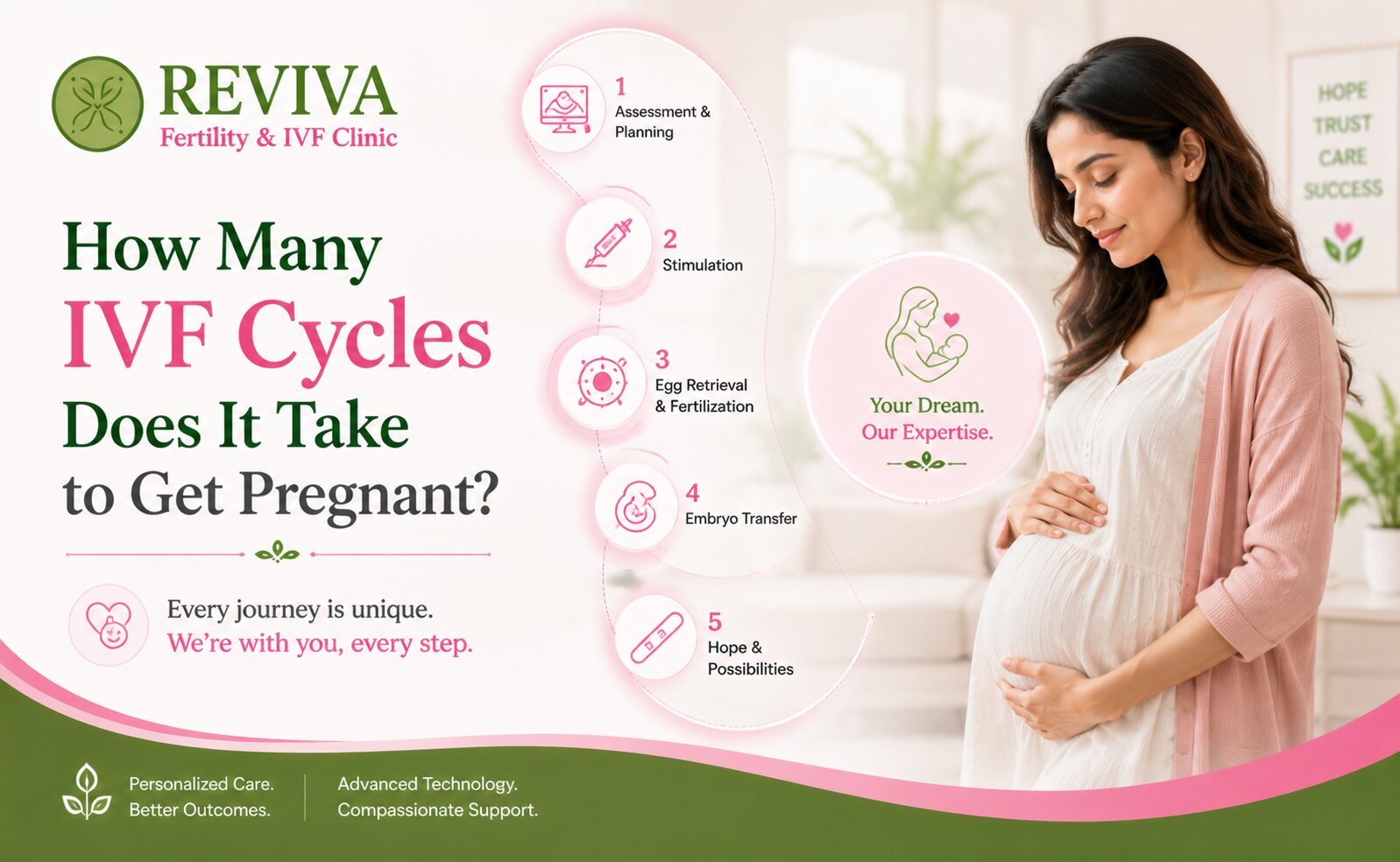
IVF is also not a single event. One treatment cycle may involve ovarian stimulation, egg retrieval, fertilization, embryo development and either a fresh embryo transfer or freezing embryos for a later frozen embryo transfer.
Therefore, the number of cycles required should be discussed in the context of the individual’s fertility diagnosis and treatment response rather than based on an average alone.
How Many IVF Cycles Are Usually Needed?
There is no universal number of IVF cycles required to achieve pregnancy.
Some patients may achieve pregnancy in their first cycle. Others may require two, three or more attempts.
The probability of success is influenced strongly by age and the characteristics of the eggs and embryos.
A patient’s response to the first IVF cycle can also provide useful information for planning future treatment.
For example, the first cycle may reveal:
- How the ovaries respond to stimulation
- How many eggs can be retrieved
- How many mature eggs are obtained
- How fertilization occurs
- How embryos develop
- Whether embryos can be frozen
- How the uterus responds to embryo transfer
This information can help a fertility specialist modify the treatment strategy if another cycle is needed.
Does IVF Work in the First Cycle?
Yes, pregnancy can occur during the first IVF cycle.
However, first-cycle success cannot be guaranteed.
A successful IVF outcome depends on a sequence of biological steps:
- The ovaries need to respond appropriately to stimulation.
- Eggs need to be retrieved.
- Mature eggs need to fertilize successfully.
- Embryos need to develop appropriately.
- A suitable embryo needs to be available for transfer.
- The embryo needs to implant.
- The pregnancy needs to continue developing.
A problem at any stage can affect the outcome.
This is why fertility specialists generally avoid promising that a particular patient will become pregnant after one specific cycle.
Does IVF Success Increase With More Cycles?
This requires an important distinction.
The chance of eventually achieving pregnancy can increase when a patient has multiple treatment attempts, but that does not mean every additional cycle has the same probability of success.
For example, if the first cycle does not result in pregnancy, the fertility team may learn important information from the response.
The treatment plan may then be adjusted based on factors such as:
- Number of eggs retrieved
- Egg maturity
- Fertilization rate
- Embryo development
- Endometrial response
- Sperm parameters
- Embryo quality
- Any complications
- Results of previous treatment
However, the benefit of additional IVF cycles varies considerably between patients.
Age and Number of IVF Cycles
Age is one of the most important factors when discussing IVF success.
As a woman gets older, both the number and quality of eggs generally decline.
This can influence:
- Number of eggs retrieved
- Embryo development
- Probability of chromosomal abnormalities
- Implantation potential
- Miscarriage risk
- Overall chance of live birth
This is why a 30-year-old and a 40-year-old may have very different IVF treatment expectations even if they undergo the same IVF protocol.
The Human Fertilisation and Embryology Authority (HFEA) also reports that IVF success rates vary according to age and other patient characteristics.
IVF Success Rate vs Cumulative Success Rate
When couples research IVF, they often look at the success rate for a single cycle.
However, another useful concept is cumulative success.
A single IVF cycle provides one opportunity to obtain embryos and attempt pregnancy.
If multiple embryos are created and frozen, one egg-retrieval cycle may potentially provide more than one embryo transfer opportunity.
For example:
One egg retrieval → multiple embryos → multiple potential embryo transfers
This means that the number of egg retrievals and the number of embryo transfers are not necessarily the same.
A couple may therefore have several transfer opportunities from a single ovarian stimulation and egg retrieval, depending on how many suitable embryos are created and frozen.
How Many Embryo Transfers Can Come From One IVF Cycle?
There is no fixed number.
It depends on:
- Number of eggs retrieved
- Number of mature eggs
- Fertilization
- Embryo development
- Number of suitable embryos
- Whether embryos are frozen
- Clinical recommendations for embryo transfer
For some patients, only one embryo may be available.
For others, several embryos may develop and be cryopreserved.
This can allow subsequent frozen embryo transfers without repeating ovarian stimulation and egg retrieval each time.
IVF Cycle vs Embryo Transfer: What Is the Difference?
These terms are sometimes used interchangeably, but they are not exactly the same.
IVF Cycle
A complete IVF treatment cycle may involve:
- Ovarian stimulation
- Monitoring
- Egg retrieval
- Fertilization
- Embryo culture
- Embryo transfer or embryo freezing
Embryo Transfer
Embryo transfer is the procedure in which an embryo is placed into the uterus.
A frozen embryo transfer may occur in a later menstrual cycle after the embryo has been cryopreserved.
Therefore, one egg retrieval does not necessarily mean one embryo transfer.
Why Does the First IVF Cycle Sometimes Fail?
An unsuccessful IVF cycle does not necessarily mean that IVF cannot work.
Several factors may contribute to an unsuccessful cycle.
1. No or Few Eggs Retrieved
Sometimes the ovaries respond less strongly than expected to stimulation.
This can be associated with ovarian reserve, age and individual response to medication.
2. Fertilization Problems
Not every retrieved egg is mature, and not every mature egg fertilizes.
Sperm factors can also affect fertilization.
In selected cases, ICSI may be considered.
3. Embryos Do Not Develop Normally
Embryos must undergo several stages of development before they can be transferred or frozen.
Not every fertilized egg develops into a suitable embryo.
4. Implantation Does Not Occur
Even when an embryo appears suitable for transfer, implantation is not guaranteed.
The interaction between the embryo and uterine environment is complex.
5. Pregnancy Ends in Miscarriage
An embryo can implant and result in a positive pregnancy test but still fail to continue developing.
Chromosomal abnormalities are one of the important causes of early pregnancy loss.
Can Doctors Change the IVF Protocol After a Failed Cycle?
Yes.
One advantage of reviewing a previous IVF cycle is that the fertility specialist has actual information about how the patient responded to treatment.
Depending on the findings, the doctor may reconsider:
- Stimulation medication
- Medication doses
- Timing of trigger medication
- Egg retrieval strategy
- Fertilization method
- Embryo culture strategy
- Timing of embryo transfer
- Endometrial preparation
- Whether additional investigations are appropriate
However, not every failed cycle requires a major change.
The appropriate decision depends on the reason for the unsuccessful outcome.
How Many IVF Cycles Should You Try Before Giving Up?
There is no universal “maximum” number of IVF cycles that applies to everyone.
The decision should be individualized.
A fertility specialist may consider:
- Age
- Ovarian reserve
- Previous IVF results
- Number and quality of embryos
- Sperm parameters
- Uterine health
- Previous pregnancies
- Financial considerations
- Emotional wellbeing
- Overall medical health
- Probability of achieving a meaningful outcome with another attempt
For some patients, another IVF cycle may have a reasonable chance of success.
For others, repeated treatment may have a lower expected benefit, and alternative approaches may need to be discussed.
Is It Better to Do Multiple IVF Cycles?
Not necessarily.
The goal of fertility treatment is not to complete as many IVF cycles as possible.
The goal is to maximize the possibility of a healthy pregnancy while considering the patient’s medical, emotional and financial circumstances.
For some women, one egg-retrieval cycle may produce several embryos, making additional stimulation unnecessary for some time.
For others, repeated stimulation may be considered because the first cycle produces few or no suitable embryos.
The decision should be based on the individual’s treatment response.
How Long Should You Wait Between IVF Cycles?
There is no single waiting period that applies to every patient.
The timing of another IVF attempt depends on:
- Recovery from egg retrieval
- Ovarian response
- Presence of ovarian cysts
- Risk of ovarian hyperstimulation syndrome
- Menstrual cycle timing
- Whether frozen embryos are available
- Need for additional investigations
- Emotional readiness
- The fertility specialist’s treatment plan
Some patients may proceed relatively soon, while others may need a longer interval.
If a frozen embryo is available, an embryo transfer may sometimes be performed without repeating ovarian stimulation and egg retrieval.
Can You Get Pregnant After One Failed IVF Cycle?
Yes.
A failed first IVF cycle does not mean future treatment will fail.
The first attempt may provide valuable information about the patient’s response to stimulation and embryo development.
For example, if the first cycle results in several good-quality embryos but pregnancy does not occur after transfer, the next treatment strategy may differ from that of a patient who produces very few eggs.
This is why reviewing the details of the cycle with the fertility specialist is more useful than simply counting the number of unsuccessful cycles.
What Factors Affect the Number of IVF Cycles Needed?
Female Age
Age is a major factor affecting egg quantity and quality.
Ovarian Reserve
Ovarian reserve can influence the number of eggs available during stimulation.
Egg Quality
Egg quality generally declines with age and can influence embryo development.
Sperm Quality
Sperm concentration, motility and morphology can influence fertilization and embryo development.
Embryo Quality
The availability and characteristics of embryos are central to IVF outcomes.
Uterine Factors
The uterus and endometrium also play an important role in implantation and pregnancy.
Cause of Infertility
The underlying diagnosis can affect treatment strategy and expected outcomes.
Previous IVF History
The results of previous cycles can help guide future treatment.
Does IVF Guarantee Pregnancy After Three Cycles?
No.
You may hear statements such as “three IVF cycles guarantee pregnancy,” but such claims should be treated cautiously.
IVF success varies between individuals, and no ethical fertility clinic can guarantee pregnancy simply based on completing a particular number of cycles.
A more useful approach is to discuss your individual estimated chance of success and how that may change with additional treatment.
How Can You Improve Your Chances During IVF?
There is no guaranteed way to make IVF successful.
However, following evidence-based medical advice can help optimize your overall health and treatment.
Follow Medication Instructions
Take fertility medications exactly as prescribed.
Do not change doses or stop medication without speaking with your fertility team.
Avoid Smoking
Smoking can negatively affect reproductive health and is best avoided when trying to conceive.
Limit Alcohol
Discuss alcohol consumption with your fertility specialist. Avoiding alcohol during fertility treatment and pregnancy is generally the safest approach.
Maintain a Balanced Diet
Focus on:
- Vegetables
- Fruits
- Whole grains
- Protein-rich foods
- Healthy fats
- Adequate hydration
There is no single fertility food that guarantees IVF success.
Maintain Appropriate Physical Activity
Follow your clinic’s advice about exercise, particularly during ovarian stimulation and after egg retrieval.
Manage Existing Medical Conditions
Conditions such as thyroid disorders, diabetes and hypertension should be appropriately managed.
Does IVF Success Depend Only on the Woman?
No.
Fertility is a couple-level issue.
Male factors can contribute significantly to infertility, which is why semen analysis and male fertility evaluation may be part of the assessment.
Depending on the diagnosis, treatment may involve:
- Ovulation treatment
- IUI
- IVF
- ICSI
- Surgery in selected cases
- Other assisted reproductive techniques
A comprehensive fertility assessment helps identify which approach is appropriate.
What If IVF Fails Repeatedly?
Repeated IVF failure can be emotionally difficult.
If several cycles have been unsuccessful, the fertility specialist may recommend reviewing the entire treatment history rather than simply repeating the same protocol.
Depending on the situation, this may involve evaluating:
- Embryo development
- Uterine anatomy
- Endometrial factors
- Ovarian reserve
- Sperm factors
- Previous stimulation response
- Relevant medical conditions
Additional testing should be guided by the patient’s individual history rather than automatically ordering every available fertility test.
Frequently Asked Questions About IVF Cycles
How many IVF cycles does it usually take to get pregnant?
There is no fixed number. Some women become pregnant after their first IVF cycle, while others require multiple attempts. Age, ovarian reserve, embryo quality, sperm factors and the underlying cause of infertility all influence outcomes.
Is the first IVF cycle the hardest?
Not necessarily. The first cycle may involve uncertainty because the doctor does not yet know exactly how the ovaries will respond. However, the results of the first cycle can provide useful information for planning future treatment.
Can IVF work after multiple failed cycles?
Yes, pregnancy can occur after previous unsuccessful IVF cycles. However, the likelihood varies considerably according to individual circumstances.
How many IVF cycles should I try at age 35?
There is no universal number. At age 35, factors such as ovarian reserve, embryo development and previous treatment response should be considered when deciding whether another cycle is appropriate.
How many IVF cycles should I try after 40?
There is no fixed number. Because fertility declines with age, women over 40 may benefit from discussing their individual prognosis and treatment options with a fertility specialist without unnecessary delay.
Can one IVF cycle produce multiple embryos?
Yes. Multiple eggs may be retrieved, and some may fertilize and develop into embryos. Suitable embryos may be transferred or cryopreserved for future use.
Do I need another egg retrieval after a failed embryo transfer?
Not necessarily. If suitable frozen embryos remain, a frozen embryo transfer may be possible without another egg-retrieval cycle.
How long should I wait between IVF cycles?
The appropriate interval varies. Your doctor may consider ovarian recovery, medical factors, previous response and whether frozen embryos are available.
Does IVF success increase after each cycle?
Cumulative chances of achieving pregnancy may increase with additional treatment opportunities, but each individual cycle does not necessarily have the same probability of success.
Is three IVF cycles enough?
Three cycles may be sufficient for some patients and not for others. The decision should be based on age, diagnosis, previous IVF results, embryo availability and expected benefit from further treatment.
Final Takeaway
There is no fixed number of IVF cycles required to get pregnant.
Some couples achieve pregnancy after their first IVF cycle, while others need multiple attempts. The number of cycles required depends on factors such as female age, ovarian reserve, egg and embryo quality, sperm health, uterine factors and the cause of infertility.
A failed IVF cycle is not automatically a reason to stop treatment. At the same time, repeating IVF indefinitely without reviewing the reasons for unsuccessful treatment is not appropriate either.
The most useful question is not simply “How many IVF cycles will I need?” but rather:
“Based on my age, diagnosis and previous treatment response, what is the expected benefit of another IVF cycle?”
A qualified fertility specialist can help answer that question using your individual medical and reproductive history.
About Reviva IVF
Reviva IVF provides fertility assessment and assisted reproductive treatment with individualized treatment planning. IVF protocols and the number of treatment attempts recommended can vary significantly from one patient to another.
If you are considering IVF or have already undergone an unsuccessful cycle, a detailed consultation can help you understand your treatment response, available options and the next appropriate step.
Medical Disclaimer: This article is intended for general educational purposes and does not provide an individual prognosis or guarantee of IVF success. IVF outcomes vary between patients. Treatment decisions should be made with a qualified fertility specialist after appropriate evaluation.


