



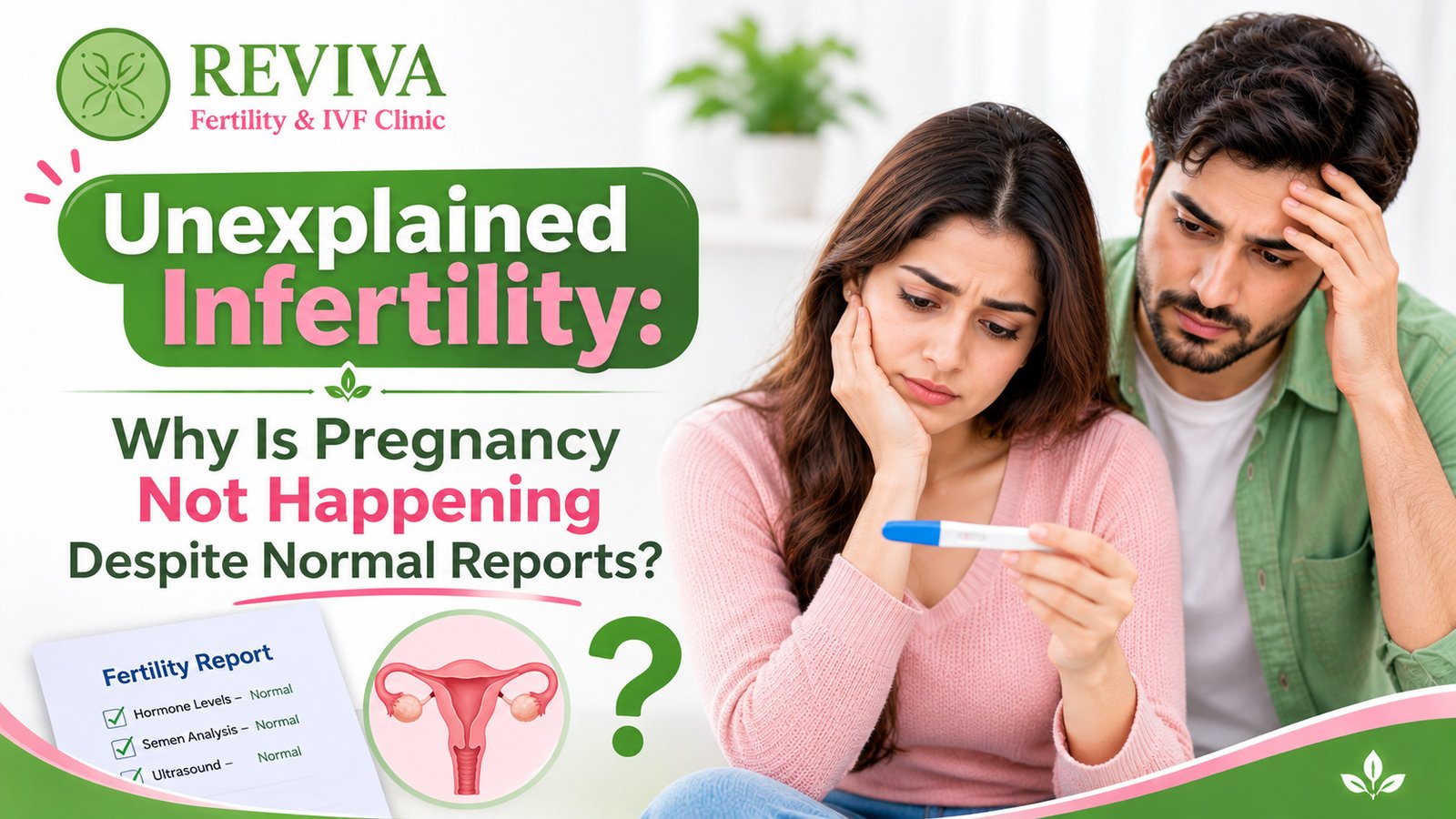
For some couples, achieving pregnancy can take longer than expected, even when initial medical investigations appear normal. Menstrual cycles may be regular, ovulation may be occurring, semen analysis may fall within reference ranges, and imaging may not reveal any significant abnormalities. Yet pregnancy may not occur.
This situation may be described as unexplained infertility.
Unexplained infertility is a recognised reproductive health condition in which standard fertility investigations do not identify a specific cause for the difficulty in conceiving. It can be challenging for couples because the absence of an identifiable abnormality does not necessarily explain why pregnancy has not occurred.
Understanding what unexplained infertility means, which investigations are involved and what treatment options may be considered can help couples make informed decisions about reproductive health.
What Is Unexplained Infertility?
Unexplained infertility is diagnosed when a standard fertility evaluation does not reveal a clear medical explanation for the inability to conceive.
The diagnosis generally requires assessment of three important reproductive factors:
- Ovulation: Whether the ovaries are releasing eggs.
- Fallopian tube function: Whether at least one fallopian tube is open and the reproductive tract is suitable for fertilisation.
- Male reproductive health: Whether semen parameters are within the relevant reference ranges.
When these initial investigations do not identify an apparent cause, unexplained infertility may be considered.
According to the American Society for Reproductive Medicine (ASRM), unexplained infertility is a diagnosis of exclusion. This means that identifiable causes must first be investigated before this diagnosis is established.
It is important to understand that normal test results do not guarantee that every aspect of the reproductive process is functioning optimally.
How Common Is Unexplained Infertility?
Unexplained infertility represents a proportion of infertility cases in which standard investigations fail to identify a specific cause.
Estimates vary depending on the diagnostic criteria, population studied and investigations performed.
The American Society for Reproductive Medicine has reported that approximately 30% of couples undergoing infertility evaluation may receive this diagnosis.
The proportion may differ across clinical settings because the extent of testing and the criteria used to establish the diagnosis are not identical everywhere.
Why Does Pregnancy Not Occur Despite Normal Fertility Reports?
Human reproduction involves several biological processes that must work together.
These include egg development, ovulation, sperm transport, fertilisation, embryo development, movement through the fallopian tube and implantation in the uterus.
Routine fertility investigations assess many of these processes indirectly. However, not every biological event can be measured accurately through standard tests.
Some possible explanations that researchers continue to investigate include the following.
1. Egg Quality and Age-Related Changes
Egg quality plays an important role in reproductive potential.
As ovarian ageing progresses, the proportion of eggs with chromosomal abnormalities generally increases. This can affect fertilisation, embryo development and the likelihood of a successful pregnancy.
Ovarian reserve tests may provide information about the expected response to ovarian stimulation, but they cannot directly measure the quality of individual eggs.
A normal ovarian reserve result also does not guarantee natural conception.
Female age remains an important factor when assessing reproductive potential.
2. Sperm Function Beyond Routine Semen Analysis
A standard semen analysis evaluates parameters such as:
- Sperm concentration.
- Total sperm number.
- Sperm motility.
- Sperm morphology.
- Sperm vitality.
However, semen analysis does not measure every aspect of sperm function.
Certain biological characteristics, including sperm DNA integrity, have been investigated in relation to reproductive outcomes.
Nevertheless, advanced sperm function tests are not routinely recommended for every couple with unexplained infertility. Their clinical usefulness depends on the individual circumstances and the available evidence.
3. Fertilisation-Related Factors
Fertilisation involves several complex interactions between the sperm and egg.
Even when routine fertility investigations appear normal, problems may occasionally occur during sperm-egg interaction or fertilisation.
These processes are not directly evaluated by every standard fertility investigation.
However, it is not possible to conclude that fertilisation is impaired simply because pregnancy has not occurred.
4. Embryo Development
Following fertilisation, the embryo undergoes several stages of cell division and development.
Not every fertilised egg develops into an embryo capable of progressing to implantation.
Chromosomal abnormalities and other biological factors may influence embryo development.
Some of these processes cannot be assessed through routine preconception investigations.
5. Implantation-Related Factors
Implantation occurs when an embryo attaches to the lining of the uterus.
The process involves interactions between the developing embryo and the endometrium, which is the inner lining of the uterus.
Hormonal regulation, endometrial development and other biological mechanisms contribute to this process.
Although implantation-related factors have been studied extensively, there is no single routine test that can comprehensively assess every aspect of implantation.
6. Subtle Reproductive or Uterine Factors
Some uterine or pelvic abnormalities may not be identified during an initial assessment.
Depending on symptoms, medical history and imaging findings, additional investigations may be considered.
Examples include further evaluation of suspected uterine cavity abnormalities, pelvic disease or other reproductive conditions.
However, additional testing should be guided by clinical indications rather than performed indiscriminately.
What Tests Are Required to Diagnose Unexplained Infertility?
The diagnosis requires a systematic assessment of both partners.
The investigations may vary according to age, medical history, menstrual patterns, previous pregnancies and other risk factors.
1. Ovulation Assessment
Ovulation is the process through which an ovary releases an egg.
A review of menstrual history is an important part of evaluating ovulatory function.
Regular menstrual cycles often indicate that ovulation is occurring.
When the menstrual history is unclear or irregular, additional investigations may be considered.
These may include:
- Hormonal blood tests.
- Progesterone testing at an appropriate point in the menstrual cycle.
- Ovulation monitoring through ultrasound.
- Other investigations when clinically indicated.
The purpose is to identify possible ovulatory disorders that may interfere with conception.
2. Ovarian Reserve Assessment
Ovarian reserve refers to the remaining quantity of eggs within the ovaries.
Common investigations include:
Anti-Müllerian Hormone (AMH):
AMH is a blood marker associated with the number of developing ovarian follicles.
Antral Follicle Count (AFC):
This is assessed through ultrasound and involves counting small follicles visible in the ovaries.
Follicle-Stimulating Hormone (FSH):
FSH may be measured at a specific point in the menstrual cycle, often alongside estradiol.
These investigations can help assess ovarian reserve and guide certain fertility treatment decisions.
However, ovarian reserve testing does not directly determine egg quality or establish whether natural conception is possible.
3. Fallopian Tube Assessment
The fallopian tubes play an essential role in natural conception.
They provide the pathway through which the egg travels and are generally the site where fertilisation occurs.
A blockage or structural abnormality may interfere with this process.
Investigations may include:
Hysterosalpingography (HSG):
An imaging procedure in which contrast material is introduced into the uterus to assess the uterine cavity and fallopian tube patency.
Saline or Contrast Sonography:
Ultrasound-based procedures may also be used to evaluate selected aspects of the reproductive tract and tubal patency.
The choice of investigation depends on clinical circumstances and available facilities.
4. Uterine Evaluation
The structure of the uterus and its cavity may be assessed through pelvic or transvaginal ultrasound.
Further investigations, such as saline infusion sonography or hysteroscopy, may be considered if an abnormality is suspected.
These procedures are not required for every individual.
5. Semen Analysis
Male reproductive evaluation is an essential part of investigating unexplained infertility.
Semen analysis assesses sperm concentration, motility, morphology, vitality and other relevant parameters.
If abnormalities are identified, additional male reproductive evaluation may be necessary.
Both partners should be assessed as part of the same fertility evaluation whenever applicable.
When Should a Couple Seek an Infertility Evaluation?
The timing of an infertility evaluation depends on age, medical history and reproductive circumstances.
In general, evaluation is recommended:
- After 12 months of regular, unprotected intercourse when the female partner is younger than 35 years.
- After 6 months when the female partner is 35 years or older.
- More promptly when the female partner is over 40 years.
An earlier evaluation may also be appropriate when there are known reproductive health conditions, irregular or absent menstrual periods, suspected tubal disease, endometriosis, previous reproductive surgery or known male-factor concerns.
These timelines are general clinical guidance and should not delay evaluation when relevant medical concerns are already present.
What Are the Treatment Options for Unexplained Infertility?
Treatment decisions depend on several factors, including:
- Age of the female partner.
- Duration of infertility.
- Previous reproductive history.
- Ovarian reserve findings.
- Semen parameters.
- Previous treatment outcomes.
- Individual medical circumstances and preferences.
There is no single treatment approach suitable for every couple.
1. Expectant Management
In selected couples, continued attempts at natural conception with appropriate monitoring may be considered.
This approach may be relevant when reproductive factors are favourable, particularly in younger individuals with a shorter duration of infertility.
The decision should take into account age and the time already spent trying to conceive.
2. Ovulation Stimulation
Ovulation stimulation involves the use of medication to influence ovarian follicle development.
In selected cases of unexplained infertility, oral medications may be used as part of a treatment plan involving intrauterine insemination.
The purpose and risks of medication use should be explained before treatment begins.
3. Intrauterine Insemination (IUI)
IUI is an assisted reproductive procedure in which prepared sperm are placed directly into the uterus around the time of ovulation.
In selected cases of unexplained infertility, IUI may be combined with controlled ovarian stimulation.
This approach may be considered depending on the couple’s age, reproductive history and other clinical findings.
Ovarian stimulation requires monitoring because the development of multiple follicles may increase the possibility of multiple pregnancy.
4. In Vitro Fertilisation (IVF)
IVF is an assisted reproductive technique in which eggs are retrieved from the ovaries and fertilised with sperm in a laboratory.
The resulting embryos are monitored during development, and an embryo may subsequently be transferred into the uterus.
IVF may be considered in unexplained infertility depending on factors such as age, duration of infertility and previous treatment history.
It is not automatically the first treatment for every couple with unexplained infertility.
The potential benefits, limitations, costs and risks should be considered before proceeding.
5. Intracytoplasmic Sperm Injection (ICSI)
ICSI is a laboratory procedure in which a single sperm is injected directly into an egg.
It is primarily used in selected cases of male-factor infertility or other specific fertilisation-related indications.
ICSI is not automatically necessary for all couples diagnosed with unexplained infertility.
Its use should be based on the clinical and laboratory findings.
Does Unexplained Infertility Mean Pregnancy Is Impossible?
No.
The diagnosis does not mean that pregnancy cannot occur.
Some couples may conceive naturally over time, while others may require fertility treatment.
The probability of conception varies according to several factors, particularly female age, duration of infertility and the reproductive history of both partners.
It is also important to understand that a diagnosis of unexplained infertility may change if further investigations identify a contributing factor.
The condition should therefore be understood as a diagnosis based on the investigations performed at a particular point in time.
Can Lifestyle Factors Influence Fertility?
General health and lifestyle may influence reproductive function.
Certain measures may support overall health and reproductive well-being:
- Maintaining a balanced and nutritious diet.
- Engaging in regular physical activity.
- Avoiding tobacco and recreational drugs.
- Limiting excessive alcohol consumption.
- Maintaining a healthy body weight.
- Managing chronic medical conditions.
- Reviewing medications with a qualified healthcare professional.
- Following appropriate preconception health recommendations.
However, lifestyle changes should not be presented as a cure for unexplained infertility.
There is insufficient evidence to suggest that a particular diet, supplement or exercise routine can reliably resolve this condition.
Frequently Asked Questions About Unexplained Infertility
1. Can unexplained infertility resolve naturally?
Yes. Some couples with unexplained infertility may conceive naturally over time. The likelihood depends on factors such as age, duration of infertility and reproductive history.
2. Can regular periods occur in unexplained infertility?
Yes. Regular menstrual cycles may indicate normal ovulatory function, but they do not assess every aspect of fertility.
3. Does normal AMH mean fertility is normal?
No. AMH provides information about ovarian reserve and may help guide fertility treatment. It does not directly measure egg quality or predict an individual’s ability to conceive naturally.
4. Is unexplained infertility the same as psychological infertility?
No. Unexplained infertility is a medical diagnosis based on the absence of an identifiable cause after standard investigations. It should not be attributed simply to stress or psychological factors.
5. Is IVF necessary for unexplained infertility?
No. IVF is one of several possible treatment approaches. Depending on age, reproductive history and clinical findings, expectant management or ovarian stimulation with IUI may also be considered.
6. Should both partners undergo fertility testing?
Yes. When applicable, male and female reproductive evaluations should be conducted in parallel. This helps identify possible contributing factors and avoids placing the responsibility for infertility on only one partner.
7. Can additional tests always identify the cause?
No. Some reproductive processes are complex and cannot be fully assessed through currently available routine investigations. Additional testing should be based on medical indications and evidence of clinical usefulness.
Conclusion
Unexplained infertility can be challenging because pregnancy does not occur despite apparently normal initial fertility investigations.
The condition highlights the complexity of human reproduction and the limitations of routine diagnostic tests.
A systematic evaluation of both partners, careful interpretation of investigations and an individualised approach to treatment are important in managing this condition.
Normal fertility reports do not necessarily mean that every reproductive process has been assessed, nor do they mean that pregnancy is impossible. Understanding the available evidence can help couples make informed decisions about their reproductive health.


